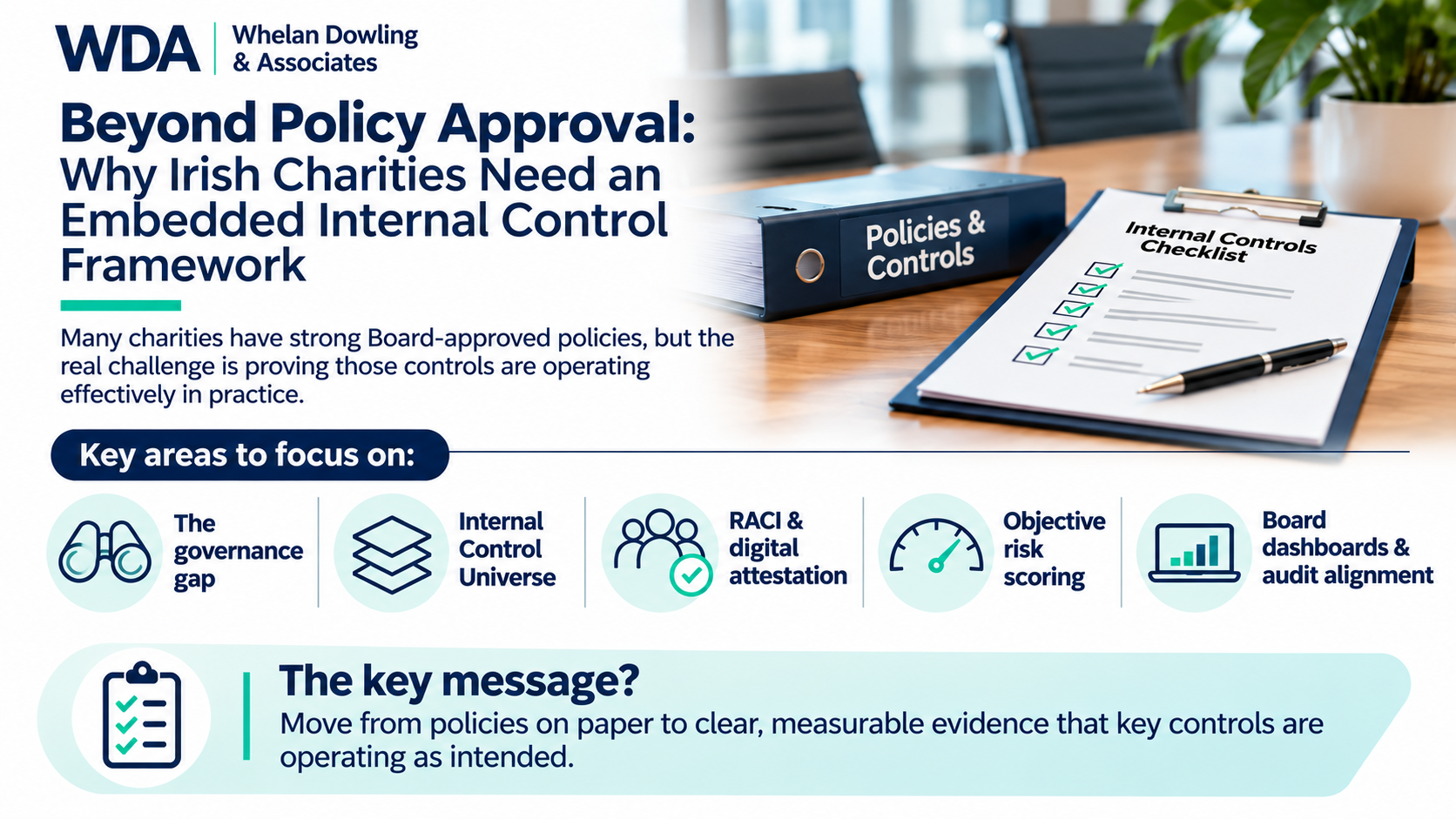
Beyond Policy Approval: Why Irish Charities Need an Embedded Internal Control Framework
Following the strong response to our recent analysis on lease accounting changes under Charities SORP 2026, a fundamental question continues to surface in our work with charity trustees, chief executives, and audit committees: how do voluntary boards move from broad regulatory compliance on paper to demonstrable, operational assurance in practice? Within the Irish not-for-profit sector, governance vulnerabilities rarely stem from an absence of documentation. Most registered charities maintain twenty to forty comprehensive, board-approved policies addressing financial management, procurement, safeguarding, data protection, and conflicts of interest. Instead, the critical vulnerability lies in the “governance gap”—the widespread, unexamined assumption by voluntary boards that approving a policy is synonymous with its day-to-day operational execution.
To support charity leaders in bridging this divide, Whelan Dowling &Associates has released our latest practical guide in the WDA Resource Centre: Building an Effective Charity Internal Controls Framework – A Practical Guide for Charity Trustees and Management. This insights article explores the core operational mechanics established in the handbook, providing charity leaders with a clear roadmap to transform static policies into an active, measurable Internal Control Universe.
1. The Policy Versus Practice Dilemma in Charity Governance
Under the Charities Act 2009, the Charities Governance Code, and the Companies Act 2014 for charitable companies limited by guarantee, trustees bear collective fiduciary responsibility to protect charitable assets, manage resources responsibly, and maintain adequate accounting records. However, in routine board practice, internal controls rarely feature as a dedicated standing agenda item. Board packs frequently include high-level qualitative updates or financial balance summaries, but very little verifiable evidence demonstrating whether operational controls are functioning effectively. This dynamic creates an inadvertent false sense of security. Voluntary trustees, conscious of not encroaching on executive management, often assume that because a policy mandates three quotes for major purchases or dual authorization on electronic bank transfers, senior management teams and operational staff are executing these checks consistently. Conversely, operational personnel, working under relentless frontline delivery pressures, may view procedural controls as discretionary administrative burdens rather than essential risk safeguards. Closing this gap requires an architectural shift: breaking down narrative policy manuals into discrete, verifiable control commitments, assigning explicit operational ownership, and establishing an independent oversight mechanism that reports objectively to the board.
2. The Operational Engine: Constructing the Internal Control Universe
The foundation of the WDA framework is the Internal Control Universe (ICU). Rather than leaving controls dispersed across dozens of standalone documents, the ICU extracts every actionable requirement into a structured master register. A practical starting point involves conducting a linguistic audit of all existing policies, filtering specifically for directive keywords:
“Must”: Mandatory, non-negotiable statutory or constitutional controls, such as dual authorization on banking transactions or annual conflict of interest disclosures.
“Should”: Sector best practice benchmarks established under the Charities Regulator Financial Controls Guidelines, such as monthly bank reconciliations with secondary independent review or formal procurement thresholds.
“May”: Discretionary operational guidelines requiring specific management approval or
contextual assessment.
Each extracted control is assigned five structural attributes: a single named operational owner, a defined testing frequency (daily, weekly, monthly, quarterly, or annual), an expected evidentiary
artifact, a mapped risk on the charity risk register, and an assigned oversight committee, such as the Audit & Risk Committee. Furthermore, the handbook recommends appending a standardised Control Schedule to the back of each approved policy document, ensuring that operational staff understand their specific compliance duties without needing to parse entire governance documents.
3. Governance Architecture: The RACI Framework and Digital Attestation
A recurring structural challenge in charity governance is role ambiguity between the Board of Trustees and the Senior Management Team. To maintain proper internal checks and balances, operational implementation must remain strictly separated from oversight and challenge.
The handbook articulates this separation through an integrated RACI Governance Framework:
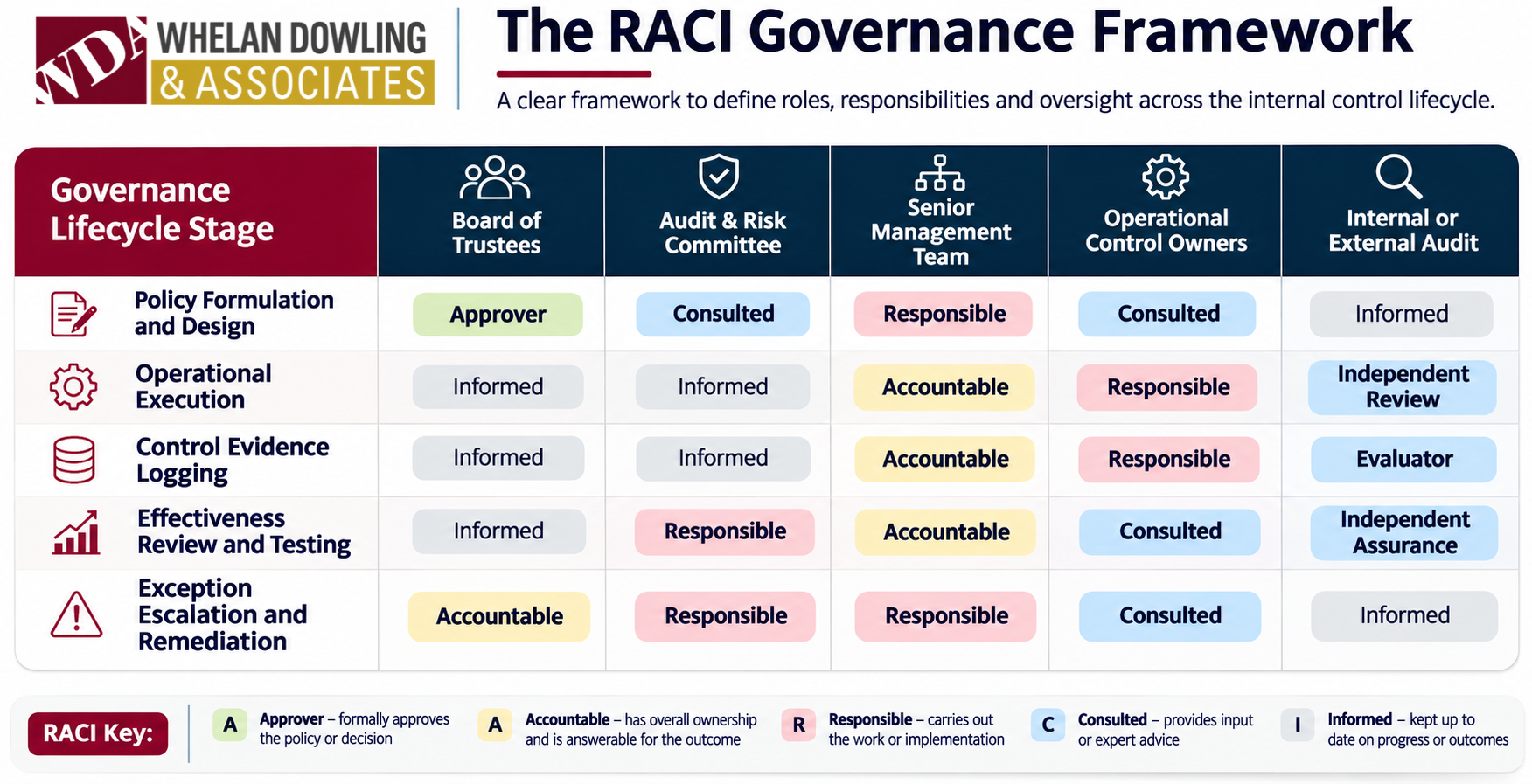
To embed accountability across the team, the framework incorporates digital policy attestations. When policies are reviewed and approved, staff, management, and key volunteers complete an
affirmative digital “read and understand” attestation. This establishes verifiable evidence of a compliance culture and ensures all personnel acknowledge their procedural responsibilities.
4. Objective Risk Scoring: Replacing Subjective Debate with Control Strength Multipliers
In conventional charity board meetings, assessing residual risk is frequently an exercise in subjective debate. A committee reviews an inherent risk, such as procurement fraud or grant clawback, and subjectively agrees on a lower residual score on the assumption that existing policies are adequate. The handbook introduces an objective model that links residual risk directly to the measured operational strength of adopted controls, using the formula:
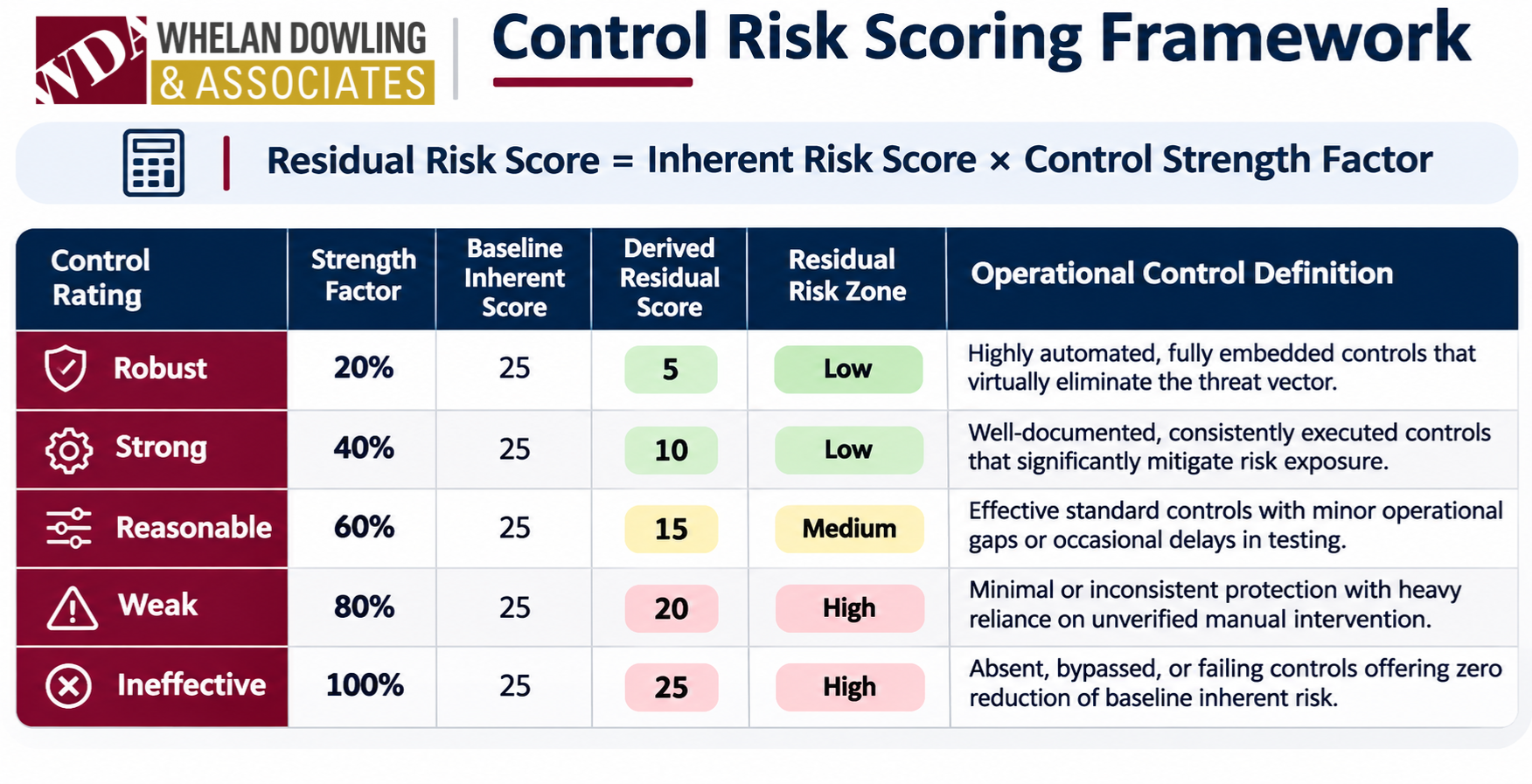
Under this model, if a key control—such as monthly bank reconciliations or supplier bank detail verification—fails or becomes overdue, the control rating automatically drops to Weak or Ineffective. Consequently, the residual risk score escalates immediately into the High risk zone on the register, prompting mandatory board scrutiny without relying on subjective consensus.
5. Executive Board Dashboards: Redefining the Board Pack
Trustees cannot be expected to inspect hundreds of individual transaction logs. Board reporting must therefore present concise, high-level summaries supported by rigorous exception detail.
The handbook outlines an executive board dashboard structured around three core visual indicators:
1. Operational Performance: Total controls executed successfully versus controls unassessed or skipped.
2. Scheduling Compliance: Controls performed up to date versus overdue reviews and unscheduled tasks.
3. Effectiveness Breakdown: The percentage distribution of controls evaluated as Green (Effective), Amber (Partially Effective), or Red (Ineffective).
Crucially, the dashboard is backed by a mandatory Exception Reporting Protocol. Behind the headline indicators, the board pack isolates every failing or overdue control, documenting:
The specific control title and unique reference number.
The assigned operational control owner.
The root cause of failure, such as staffing vacancies or workflow bottlenecks.
The immediate compensating mitigation implemented.
The linked strategic risk on the corporate risk register.
The binding target date for full remediation.
This reporting structure transforms board meetings from passive presentations into targeted governance sessions focused directly on resolving operational vulnerabilities.
6. The Auditor Perspective: Aligning with ISA Auditing Standards
For charities subject to statutory financial audit, establishing an active Internal Control Universe delivers substantial operational efficiencies. During audit planning and interim testing, statutory auditors operate under International Standards on Auditing (Ireland):
ISA 315 (Identifying and Assessing the Risks of Material Misstatement): Auditors must evaluate the Design and Implementation of internal controls across material transaction streams, including Income, Payroll, Expenditure, and Banking. Where a charity maintains a structured control universe with documented audit trails, system walkthrough tests can be
conducted efficiently, reducing substantive sample testing and year-end disruption.
ISA 265 (Communicating Deficiencies in Internal Control): Where auditors identify
material weaknesses, they are required to report these in writing as significant deficiencies to
Those Charged with Governance. An active internal framework detects and remediates these
issues internally long before the external audit commences.
ISA 240 and Management Override: External auditors must assess fraud risks and the risk of management override of controls. Centralised policy registers, digital access logs, and
strict dual-signatory online banking workflows provide auditors with positive assurance regarding the entity's control environment. Internal controls also directly validate the fundamental financial statement assertions made by trustees in the annual accounts:
Income and Expenditure Assertions: Occurrence, Completeness, Accuracy, Classification, and Cut-Off.
Balance Sheet Assertions: Existence, Rights and Obligations, Completeness, Valuation and Allocation, and Cut-Off.
7. Implementation: A Phased 12-Month Roadmap
Auditing dozens of policies simultaneously can overwhelm an organisation. The handbook outlines a phased roadmap designed to generate quick governance wins while building sustainable capability:
Phase 1: Foundation and High-Risk Core (Months 1 to 3): Formalise Board and Audit Committee terms of reference, audit primary financial policies (Banking, Purchasing, Payroll, and Expenses), extract critical controls into the ICU, and enforce dual-authorisation banking
protocols.
Phase 2: Operational Expansion and Attestation (Months 4 to 6): Establish the central Policy Register, introduce digital staff attestations, link the Control Assessment Table with the
Risk Register, and incorporate core safeguarding policies.
Phase 3: Board Dashboard Integration (Months 7 to 9): Deploy the consolidated performance, review, and effectiveness dashboard into quarterly board packs, establish the
exception reporting protocol, and conduct initial walkthrough testing on high-risk areas.
Phase 4: Full Institutional Embedding (Months 10 to 12): Expand the ICU across remaining operational and IT governance policies, conduct an annual review of control
effectiveness under the Charities Governance Code, and coordinate audit planning under ISA 315.
Access the Complete Practical Handbook
Whether your charity is preparing for its statutory audit, updating its compliance records under the
Charities Governance Code, or strengthening trustee oversight, establishing an active Internal Control Universe is a proven step forward.
The complete handbook, Building an Effective Charity Internal Controls Framework – A Practical
Guide for Charity Trustees and Management, is available to download from the WDA Resource Centre
https://wda.ie/resource-centre/
The guide includes detailed policy review methodologies, sample RACI matrices, the mathematical control assessment table, and board dashboard templates.