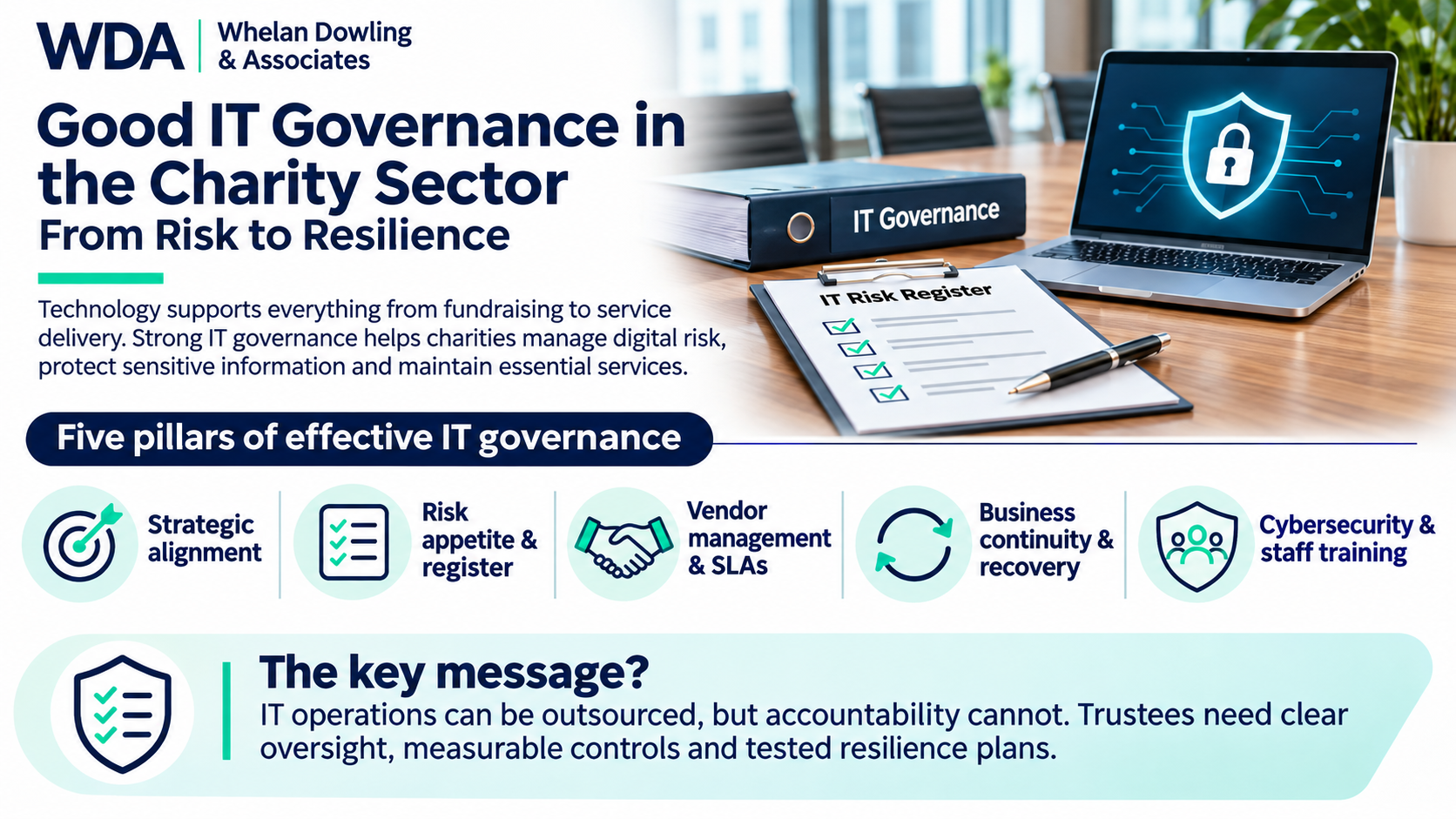
Good IT Governance in the Charity Sector: From Risk to Resilience
The modern operating landscape has made digital connectivity indispensable for Ireland’s charitable and non-profit organisations. Technology powers fundraising platforms, maintains donor databases, coordinates volunteer networks, and enables daily frontline service delivery. Yet, as digital dependency deepens, a systemic governance gap persists across boardroom tables: treating
information technology as an operational utility rather than a core strategic discipline. A recent suspected cyber-attack on the Irish credit union sector serves as an urgent wake-up call for charity trustees and senior management teams. If regulated financial institutions—subject to rigorous Central Bank of Ireland oversight, mandated digital operational resilience standards under the Digital Operational Resilience Act (DORA), and substantial technology budgets—remain vulnerable to sophisticated disruptions, Ireland’s charities are operating on the frontline of an increasingly unforgiving threat environment.
Addressing the Fine Gael parliamentary party, Tánaiste and Minister for Finance Simon Harris described the suspected cyber-attack on the credit union sector as: “a matter of concern and a sharp reminder the modern reality countries face… the question is no longer whether organisations will face cyber-attacks, but rather ensuring they are sufficiently prepared to withstand and respond to them.” For charity trustees, who carry legal and fiduciary obligations to safeguard charitable assets and protect beneficiary data, this shift from “if” to “when” demands an immediate transition from passive complacency to proactive, structured IT governance. To assist trustees and senior leaders in navigating this terrain, Whelan Dowling & Associates has published its comprehensive guide, Effective IT Governance: A Practical Guide for Charities, available through the WDA Resource Centre.
1. The Vulnerability Paradox: Why Charities Face Heightened Exposure
The regulatory review of IT risks within financial institutions demonstrates that technological vulnerability is rarely just a technical problem; it is fundamentally a governance issue. The Central Bank of Ireland’s thematic reviews into credit unions highlighted that even institutions handling member funds frequently exhibited critical deficiencies: weak board oversight, an absence of comprehensive IT risk registers, undocumented recovery procedures, and an over-reliance on external IT providers. For registered charities, these systemic vulnerabilities are often compounded:
Asymmetric Resources: Unlike commercial or regulated financial entities, non-profits operate under lean administrative margins, often leading to chronic underinvestment in
technology infrastructure.
The Make Do and Mend Mentality: Many organisations cling to the traditional mindset of; “we will use it until it dies” Retaining outdated hardware and unsupported operating systems
creates known vulnerabilities that external threats exploit.
High-Value Data Targets: Irish charities frequently process sensitive personal data, vulnerable service-user records, donor payment details, and health information, making them
significant targets for data theft and extortion.
The Human Factor: While external threats deploy sophisticated methods, the overwhelming majority of cyber breaches stem from human error. The Data Protection Commission (DPC)
recorded 7,781 valid breach notifications in 2024 alone, an 11% increase on the prior year. The voluntary and charity sector accounted for 251 formal breach notifications, with basic
correspondence errors and phishing remaining predominant entry routes.
The 2021 cyber-attack on Ireland’s Health Service Executive (HSE) remains a stark case study in how small vulnerabilities cascade into national crises. In that incident, an initial compromise via a phishing email containing an infected file allowed undetected access for almost eight weeks before core IT systems across the country had to be shut down. For a charity, an extended intrusion could result in total operational paralysis, reputational devastation, and regulatory enforcement.
2. Breaking the Fallacy: Out of Sight, Out of Mind
The most prevalent vulnerability within the non-profit sector is the assumption that outsourcing day-to- day technical support eliminates organisational risk. Charities frequently engage a third-party Managed Service Provider (MSP) and adopt an out of sight, out of mind; posture, assuming the provider has assumed total responsibility for digital resilience. This assumption is both incorrect and legally precarious. An organisation can outsource operational execution, but the board of directors can never outsource statutory accountability. To govern effectively, charities must establish a formal accountability matrix that delineates the operational boundaries between technical delivery, management coordination, and strategic oversight:
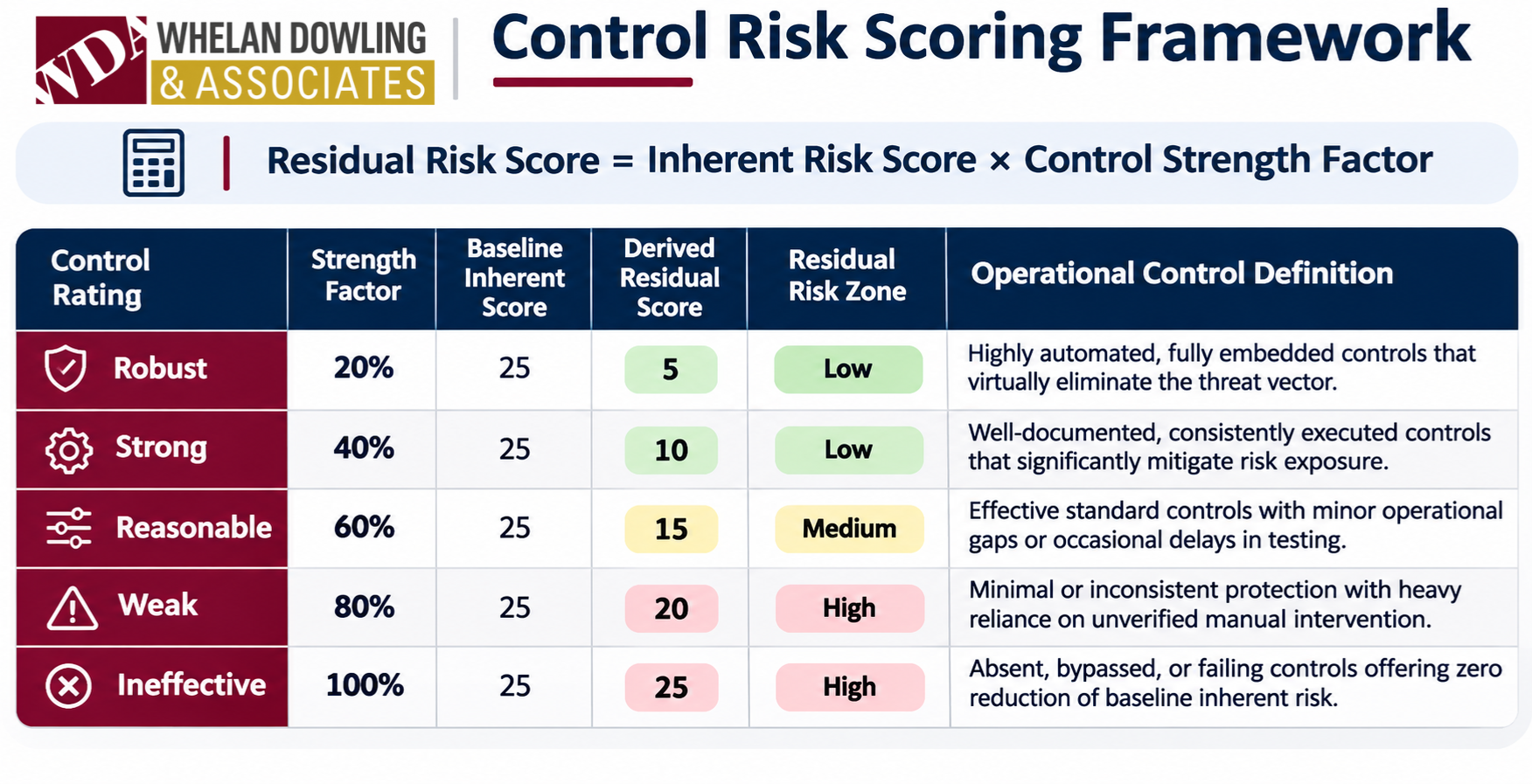
When boards abdicate their role, treating IT as “Any Other Business”;(AOB) at the end of static agendas, the charity accumulates unmonitored technical debt, misaligned vendor contracts, and
unmitigated exposures.
3. The Legal and Regulatory Mandate: What Regulators Expect
IT governance is not an optional operational enhancement; it is an explicit legal duty. In Ireland, several interlocking regulatory frameworks demand active board-level supervision of technology: The Charities Governance Code Under Principle 4 (Exercising Control), trustees must ensure that appropriate internal financial and operational controls are in place to protect the charity’s assets and resources. Digital infrastructure, proprietary systems, and donor records constitute vital charitable assets. Principle 6 (Being Accountable and Transparent) mandates that trustees stand over organisational stewardship. Board minutes that reflect zero engagement with IT risk indicate a failure to exercise requisite control. GDPR and Data Protection Legislation
Under Article 24 and Article 32 of the General Data Protection Regulation (GDPR), charities acting as data controllers are legally required to implement appropriate technical and organisational measures to ensure a level of security appropriate to the risk. The Data Protection Commission expects charities to maintain a comprehensive Record of Processing Activities (RoPA) under Article 30, enforce strict access controls, and report reportable data breaches within 72 hours. Operating legacy systems that no longer receive security patches exposes charities to severe enforcement, including substantial administrative fines, mandatory corrective orders, and catastrophic reputational damage. International Standard on Auditing (ISA Ireland 315) Under the revised ISA (Ireland) 315 standards, statutory auditors are required to identify and assess risks of material misstatement arising from an entity’s IT environment. Auditors must examine General IT Controls (GITCs)—including user access management, IT change controls, and operational continuity—evaluating whether automated and manual controls sufficiently safeguard financial
records. Weak IT controls directly impact audit assessments and governance reporting.
4. Five Pillars of a Robust Charity IT Governance Framework
To establish a resilient posture that withstands regulatory scrutiny and operational disruption, boards and senior leadership must embed five core pillars into their governance lifecycle:
Pillar 1: Strategic Alignment: Technology must actively serve the charity’s charitable mission. Boards must demand a documented, approved IT strategy—either as a dedicated plan or a clearly articulated sub-section of the multi-year strategic plan. This roadmap must account for emerging operational requirements, define resource allocation, and balance capital investments against maintenance costs.
Pillar 2: Defined IT Risk Appetite and Formal Risk Registers
Risk cannot be managed until it is defined. Boards must formally articulate their IT risk appetite, establishing quantifiable boundaries for operational tolerance. For most non-profits handling donor
funds and vulnerable client records, a "Minimalist" (Low) risk appetite is appropriate. This policy must be supported by a living IT Risk Register that identifies threats (such as severe cyber attacks, data mismanagement, or server failures), evaluates inherent risk scores, tests the strength of existing controls, and tracks residual scores against board-approved thresholds.
Pillar 3: Active Vendor Management and Robust SLAs
Trustees must eliminate blind reliance on outsourced providers. Contracts with MSPs must be supported by enforceable Service Level Agreements (SLAs) containing clear performance indicators,
guaranteed response times, and actionable penalties for service failures. Furthermore, charities must maintain an exit management strategy and demand absolute clarity regarding data jurisdiction,
ensuring cloud storage locations and third-party data processing agreements comply fully with European data privacy standards.
Pillar 4: Tested Business Continuity and Disaster Recovery
A backup strategy is not a recovery plan. The Central Bank’s supervisory reviews identified a widespread failure among organisations to distinguish between saving data and restoring operations. Boards must require regular, documented “backup restore tests” to verify that critical applications can actually be recovered within defined recovery time objectives. Resilience plans must incorporate severe but plausible scenarios, including extended network outages, severe system disruption, and the unexpected insolvency or compromise of an external IT supplier.
Pillar 5: Cybersecurity Defences and the “Human Firewall”
Technical safeguards—such as multi-factor authentication (MFA) across all remote access and administrative accounts, next-generation endpoint security, and network segmentation—are essential
baselines. However, technical defences must be reinforced by continuous staff education. Implementing regular, mandatory cybersecurity training alongside unannounced simulated phishing exercises transforms personnel from a primary vulnerability into a resilient frontline defence.
5. Reporting to the Board “In English” Transforming Technical Jargon into Governance Insights
A frequent obstacle reported by charity trustees is the inability to decipher technical reports presented by IT technicians or external vendors. When board packs are filled with unintelligible technical logs, trustees cannot discharge their duty to challenge and probe.
Boards must mandate that management provide an executive-level IT Governance Dashboard structured around clear business metrics:
Cybersecurity Posture Index: Utilising objective, third-party benchmarks—such as the
Microsoft Secure Score—to provide a transparent percentage score reflecting the charity's
overall security health relative to sector averages.
Phishing Simulation Metrics: Tracking staff failure and reporting rates over time,
highlighting where targeted refresher training is needed.
System Availability and Downtime: Measuring actual operational uptime for critical systems (such as donor databases and accounting software) against agreed SLA targets.
Patching and Lifecycle Hygiene: A clear traffic-light status on critical software patches and a timeline for upgrading obsolete operating systems or hardware before vendor support
deadlines.
Incident and Threat Reporting: Documenting attempted and blocked attacks, near-misses, and the actionable lessons learned to continuously reinforce internal defences.
Key Questions Every Board Must Ask
To hold senior management and external providers to account, trustees should incorporate targeted questions into their standing board agendas:
1. Does our IT strategy explicitly support our strategic goals for the next 12 to 24 months, and is it backed by a dedicated capital and operational budget?
2. Can management confirm that our residual IT risk scores fall strictly within our approved risk appetite, and what are the remediation timelines for any items marked high?
3. When was our Disaster Recovery Plan last tested in a live simulation, and how long would it take to restore operations if our primary server or cloud repository suffered a major outage?
4. Have we reviewed our MSP’s own business continuity plan to ensure our charity is not left exposed by a disruption within their infrastructure?
5. Is Multi-Factor Authentication (MFA) strictly enforced across all user logins, remote access portals, and privileged administrative accounts without exception?
Moving from Compliance to Leadership: The WDA Practical Roadmap
Strengthening IT governance is an iterative journey of continuous improvement rather than an overnight overhaul. By adopting a structured 12-month phased roadmap, charities can systematically
eliminate systemic vulnerabilities:
Phase 1 (Immediate / Month 1): Commission an independent IT risk assessment; compile a comprehensive inventory of all hardware, software, and data assets; and establish a formal IT
Risk Register.
Phase 2 (Short-Term / Months 2–6): Review and tighten MSP contracts and SLAs; update Data Protection policies and Disaster Recovery plans; and roll out mandatory staff
cybersecurity training with phishing simulations.
Phase 3 (Medium-Term / Months 6–12): Execute hardware upgrade plans to retire non-compliant systems; implement a quarterly board-level IT dashboard reported in plain English;
and conduct an independent penetration test.
Good governance protects the mission, safeguards donor trust, and secures the future of the organisation. It is not an administrative burden, but a vital leadership duty.
Download the Complete Handbook
To support trustees, chief executives, and finance leaders in implementing these standards, Whelan Dowling & Associates has developed Effective IT Governance: A Practical Guide for Charities.
The publication includes complete diagnostic checklists, sample IT risk appetite statements, trustee question frameworks, and technical comparison matrices.
Download your complimentary copy directly from the WDA Resource Centre at wda.ie/resource-centre.