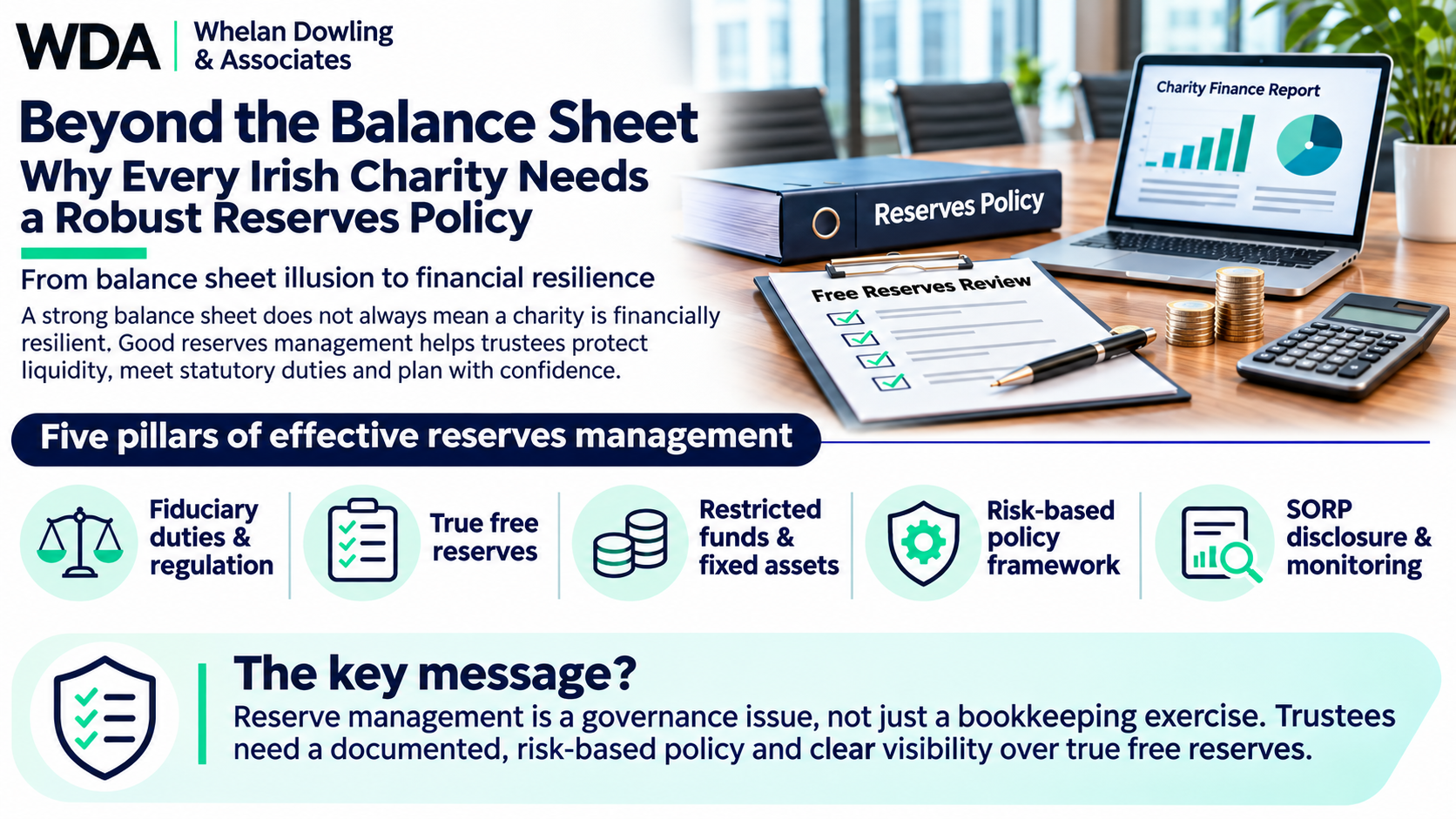
Beyond the Balance Sheet: Why Every Irish Charity Needs a Robust Reserves Policy A healthy bank balance on a charity’s balance sheet can be dangerously misleading. For boards of trustees, charity directors, and chief executives across Ireland, maintaining organizational resilience is no longer just sound financial administration—it is a statutory imperative under the Charities Act 2009, the Charities (Amendment) Act 2024, and the Charities Statement of Recommended Practice (SORP FRS 102).
To assist charity leaders in navigating evolving statutory expectations and funding volatility, Whelan Dowling & Associates has published a comprehensive strategic handbook, A Trustee’s Guide to Reserve Management for Irish Charities: Securing Your Future. This document synthesises core insights from the finalised handbook, examining statutory duties, the precise accounting mechanics of free reserves, common solvency pitfalls, and a structured roadmap for policy development and reporting.
1. The Shifting Regulatory Landscape and Codified Fiduciary Duties
Reserve management is fundamentally an issue of governance, stewardship, and accountability rather than routine bookkeeping. Historically, voluntary organisations frequently operated under the misconception that retaining reserves conflicted with their core mission to apply income directly to beneficiaries. Contemporary statutory frameworks clarify that holding an unjustified surplus or
operating without an adequate safety cushion exposes trustees to regulatory sanctions and operational peril.
Under Irish law, the responsibilities governing reserve management are established across multiple statutes:
The Charities (Amendment) Act 2024: Section 54A formally codifies charity trustees’ fiduciary duties for the first time in Irish legislation. Trustees carry an explicit statutory obligation to act in good faith, in the best interests of the charity, and to exercise reasonable care, skill, and diligence. Crucially, this includes managing the financial affairs of the organisation in a prudent and responsible manner.
Companies Act 2014: For Charities Limited by Guarantee (CLGs), company directors hold personal legal responsibilities to ensure the company remains solvent. Incurring liabilities without a reasonable expectation of discharging them as they fall due constitutes reckless trading under company law.
Charities Regulatory Authority (CRA) Guidance: Issued under Section 14(1) of thebCharities Act 2009, CRA guidance encourages the effective application of charitable property. While trustees possess an implied power to maintain income reserves to ensure operational continuity, this power must be exercised prudently and substantiated through a formal, board-
approved policy.
High Court Enforcement (Section 74): Under the Charities Act 2009, the High Court holds broad statutory authority to intervene—including freezing bank accounts, restraining transactions, or removing trustees—where charitable assets are misapplied, wasted, or placed at risk through financial mismanagement. Documenting a reasoned, risk-based reserves policy serves as primary documentary evidence that trustees are fulfilling their fiduciary obligations and actively protecting charitable property against foreseeable operational shocks.
2. Defining “Free Reserves”: Deconstructing the Balance Sheet
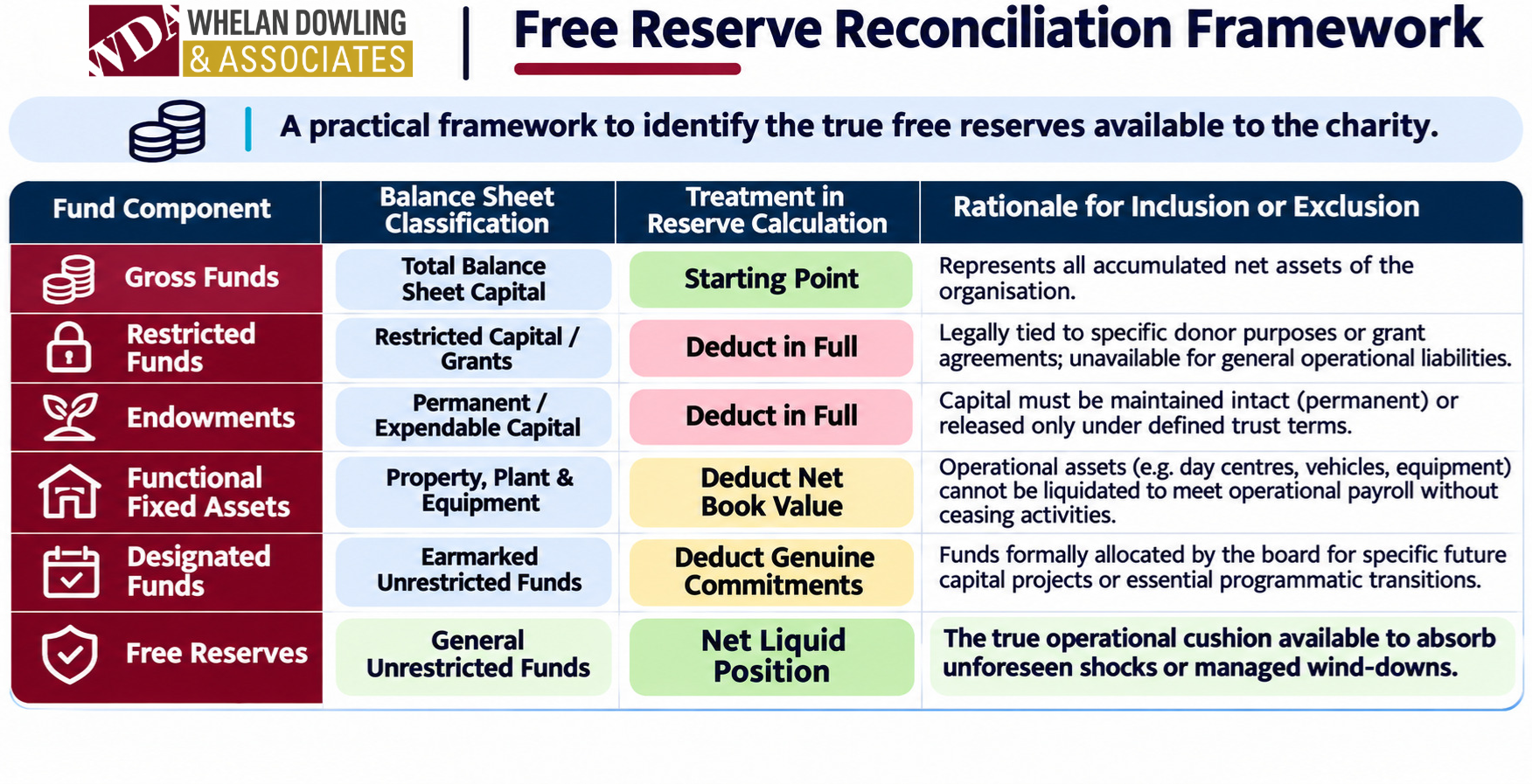
A frequent source of governance failure is the conflation of total funds or cash-at-bank with available reserves. In charitable accounting, funds are segregated by legal restriction and practical liquidity. Regulatory bodies and standard-setters define charitable reserves strictly as: That part of a charity’s unrestricted funds that is freely available to spend on any of the charity’s purposes. Calculating true free reserves requires systematically isolating restricted income, illiquid functional assets, and genuine board commitments from the gross fund balance.
Free Reserve Reconciliation Framework:
 Critical Accounting Distinctions
Restricted Funds versus Unrestricted Funds
Restricted funds arise when a donor, grantor, or public appeal explicitly specifies the objective for which the resources must be applied. Using restricted funding to cover general administrative overheads, bridge unrestricted revenue deficits, or settle unsecured trade creditors is unlawful and constitutes a direct breach of trust under the Charities Act 2009.
Functional Fixed Assets versus Realisable Investments
Tangible fixed assets held directly for operational purposes—such as freehold premises used for service delivery or specialised vehicles—do not represent spendable liquidity. Unless an asset is held as an investment property that can be disposed of without disrupting charitable services, its carrying value must be removed when evaluating operational resilience.
Board Designations and the Prohibition of “Window Dressing”
Designated funds represent unrestricted monies that trustees have administratively earmarked for a designated purpose, such as an upcoming IT migration or a building maintenance fund. Because
designated funds remain legally unrestricted, trustees retain the administrative authority to undesignate them if an emergency arises. However, standard-setters and regulators strictly prohibit creating designations retrospectively after year-end simply to reduce an apparent operating surplus. Designations must reflect pre-existing strategic commitments documented in board minutes prior to the balance sheet date.
3. The Balance Sheet Illusion: A Comparative Tale of Two Charities
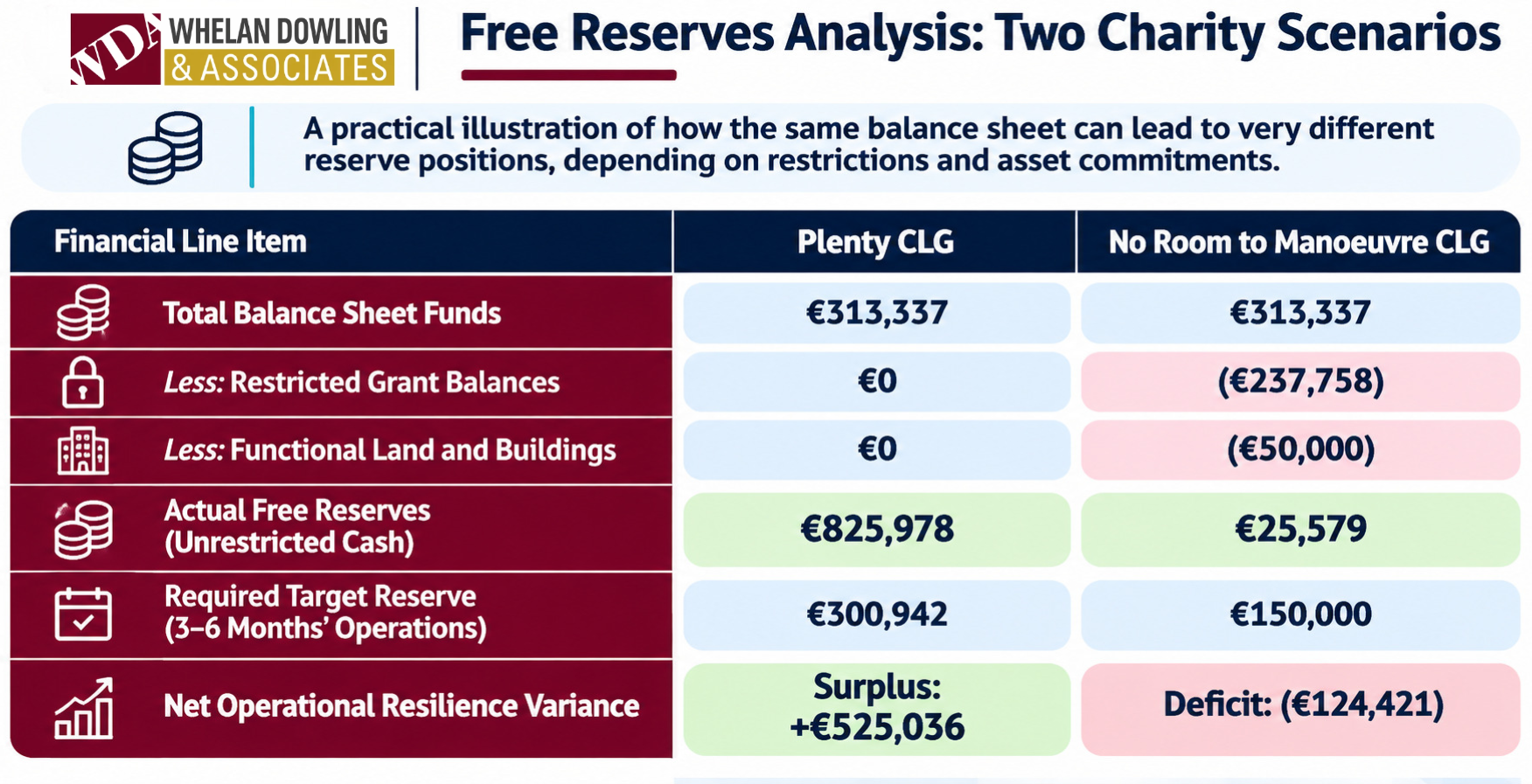
To demonstrate how headline balance sheet figures can mask severe operational distress, the handbook examines a comparative case study of two fictional organisations: Plenty CLG and No Room to Manoeuvre CLG. Both charities report identical headline net assets on their audited balance sheets, yet their operational resilience profiles diverge entirely.
Comparative Position
Analytical Diagnosis
In this comparative scenario, No Room to Manoeuvre CLG presents a superficial image of solvency. A stakeholder glancing solely at total net assets of €313,337 would infer that the charity is well-capitalised. In reality, €237,758 of that balance is legally ring-fenced for restricted projects, and €50,000 is tied up in functional equipment. The organisation possesses only €25,579 in freely accessible reserves. Because No Room to Manoeuvre CLG requires €150,000 to cover baseline operational expenditure across a three-month period, the charity operates in a structural deficit of €124,421. Should a primary statutory funder delay grant disbursements by sixty days, the charity would immediately exhaust its liquid cash, exposing directors to personal liability for continuing to incur debts while insolvent. Conversely, Plenty CLG holds a substantial unrestricted cash buffer exceeding its risk-adjusted requirement by €525,036. While solvent, Plenty CLG faces a different governance dilemma: failing to articulate a strategic plan for deploying this surplus risks alienating donors, who may question why charitable donations are being accumulated rather than expended on core social objectives.
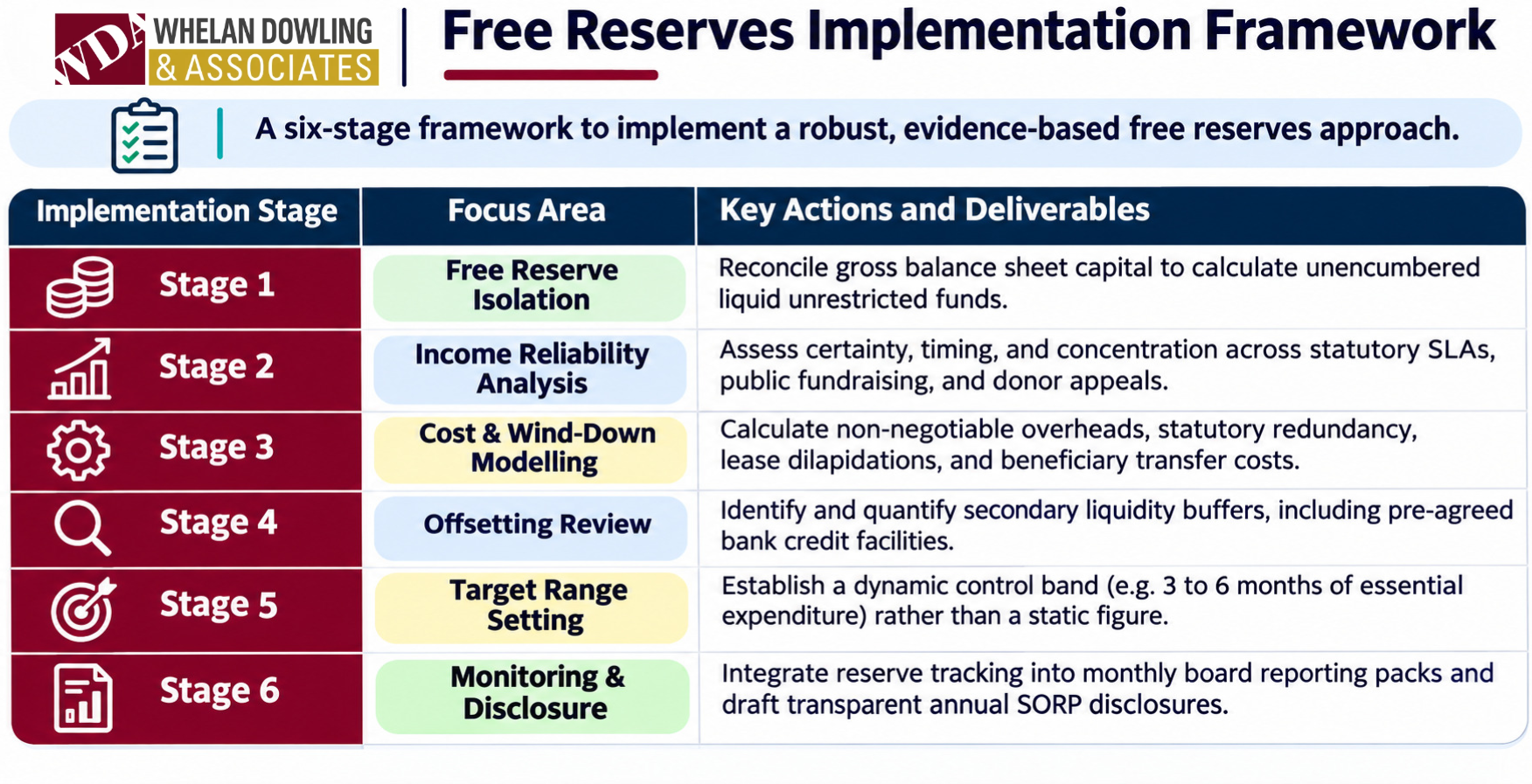
4. Developing a Defensible Reserves Policy: The Six-Step Risk-Based Framework
A robust reserves policy replaces arbitrary rules of thumb with an evidence-based risk assessment. Rather than relying on rigid formulas, trustees should follow a structured sequence that systematically models income predictability, core operational costs, and potential wind-down obligations.
 Step 1: Establish True Free Reserves
Strip away restricted balances, permanent endowments, and functional fixed assets to establish the charity’s true baseline of unencumbered liquid capital.
Step 2: Assess Income Stream Reliability
Analyse the predictability, timing, and vulnerability of all revenue sources. Multi-year Service Level Agreements (SLAs) with statutory agencies carry high predictability, whereas legacy gifts, corporate sponsorships, and public street collections carry high volatility. Organisations heavily reliant on discretionary public fundraising must maintain larger reserve buffers than those operating on multi-year statutory grants.
Step 3: Model Core Expenditures and Orderly Wind-Down Commitments
Identify non-negotiable operational commitments. In addition to regular overheads, the policy must calculate the financial liabilities of an orderly cessation of activities should catastrophic funding loss occur:
1. Statutory redundancy obligations for staff based on years of continuous service.
2. Property lease commitments and potential dilapidation settlements.
3. Contractual notice periods with key service providers, IT vendors, and utility suppliers.
4. Client and beneficiary transition costs, ensuring duty of care is maintained while transferring
service users to alternative providers over a three-to-six-month horizon.
Step 4: Evaluate Offsetting Mitigations
Factor in internal and external liquidity buffers, such as agreed bank overdraft facilities, revolving credit agreements, or financial support guarantees from parent foundations.
Step 5: Formulate an Operational Range
Express the reserve target as a dynamic range rather than a fixed monetary figure. A dynamic range (such as “between three and six months of essential operating costs, representing €180,000 to €250,000”) accommodates seasonal cash flow fluctuations while establishing clear upper and lower control limits.
Step 6: Embed Ongoing Monitoring and Annual Review
Reserve management cannot be treated as an isolated year-end compliance task. Free reserves should be tracked within monthly management accounts alongside rolling 12-month cash flow forecasts. The board should formally re-evaluate the target range annually during the budgetary cycle to reflect inflation, workforce expansion, or shifting risk profiles.
5. Financial Reporting and Statutory Disclosures under Charities SORP
Transparency in external reporting converts compliance into a strategic asset. Under Charities SORP (FRS 102) and the upcoming SORP 2026 framework, trustees must include a comprehensive reserves statement within their annual Trustees Report.
Required Disclosure Components
The Stated Policy: The board’s agreed target reserve level or range, along with the detailed rationale explaining how that figure was derived from organisational risks.
The Actual Position at Balance Sheet Date: The exact amount of free reserves held at year-end, accompanied by a clear reconciliation back to the balance sheet where the figure is not directly identifiable from the primary statements.
Variance Justifications:
o Addressing an Under-Target Position (Deficit): If free reserves fall below the lower control threshold, trustees must state the explicit corrective actions being taken to restore balances over a defined timeframe (e.g. budgeting an annual operating surplus of €30,000 over three consecutive fiscal years).
o Addressing an Over-Target Position (Surplus): If reserves substantially exceed the target, trustees must outline intended capital investments, service expansion plans, or innovation funds to demonstrate that charitable resources are not being hoarded unnecessarily.
Going Concern Assessment: Where reserves are depleted or negative, trustees and auditors must provide detailed evaluations confirming that the charity remains a going concern based on robust cash flow projections extending at least twelve months from the approval date of the financial statements.
6. Strategic Takeaways and Actionable Next Steps for Charity Boards
Establishing a disciplined reserve management framework shields a charity from external financial shocks while building enduring trust with funders, donors, and regulatory authorities.
Boards should initiate the following action checklist at their next governance meeting:
1. Conduct a Free Reserve Reconciliation: Direct the finance team to isolate restricted funds and functional fixed assets from unrestricted balances to determine current true liquidity.
2. Review Wind-Down Liabilities: Calculate statutory redundancy entitlements and contractual notice liabilities across all leased premises and ongoing vendor contracts.
3. Draft or Update the Written Reserves Policy: Benchmark the organisation’s current position against the six-step framework and define a board-approved operational target range.
4. Incorporate Reserves into Monthly Reporting: Ensure monthly executive reporting packs include a free reserves dashboard metric comparing actual liquidity against the target range.
5. Align Financial Statement Disclosures with SORP Standards: Ensure the upcoming Trustees; Annual Report provides a clear narrative that articulates the policy, explains any
variances, and reinforces organizational transparency.
The complete strategic handbook, A Trustee’s Guide to Reserve Management for Irish Charities:Securing Your Future, is available for download through the Whelan Dowling & Associates
Resource Centre at https://wda.ie/resource-centre/